A String in Java is a widely used object that stores a sequence of characters.
One of the most important properties of the String class in Java is that it is immutable.
✅ What Is an Immutable Object?
An immutable object is an object whose state (data) cannot be changed after it is created.
- Once a string is created, its content cannot be altered.
- Any modification creates a new string object.
✔️ Example of Immutable Behavior
public class ImmutableStringExample {
    public static void main(String[] args) {
        String str = "Java";
        str.concat("Knowledge Base");  // This does NOT modify the original str

        System.out.println(str);  // Output: Java
    }
}
👉 To get the modified string, you must explicitly assign it:
str = str.concat("Knowledge Base");
System.out.println(str);  // Output: Java Knowledge Base
✅ Why Is String Immutable in Java?
1️⃣ String Pool Benefit
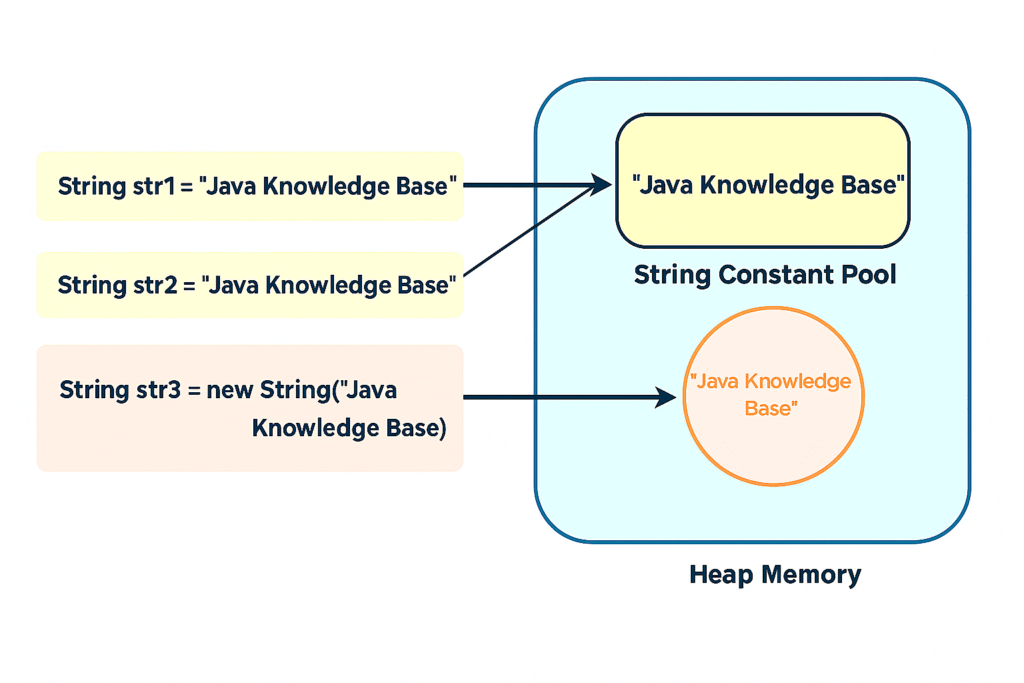
When dealing with strings in Java, a key concept that improves performance and memory management is the String Constant Pool (or String Pool).
✅ What Is the String Pool?
- The String Pool is a special memory region in the Java heap.
- It stores unique string literals.
- Every time a string literal is created using double quotes (
" "), the JVM checks the pool first:- If the string already exists → It reuses the same reference.
- If the string doesn’t exist → It adds the string to the pool.
✅ Example: String Pool Behavior (literals)
public class StringPoolExample {
    public static void main(String[] args) {
        String str1 = "Java Knowledge Base";
        String str2 = "Java Knowledge Base";
        System.out.println(str1 == str2);  // Output: true
    }
}
👉 Explanation:
- Both
str1andstr2point to the same object in the String Pool. - The
==operator returnstruebecause both variables reference the same memory address.
✅ Example: Using new Keyword
public class StringPoolExample2 {
    public static void main(String[] args) {
        String str1 = "Java Knowledge Base";
        String str3 = new String("Java Knowledge Base");

        System.out.println(str1 == str3);  // Output: false
    }
}
👉 Explanation:
str1refers to the pooled string object.str3refers to a new object in the heap memory.- Therefore,
str1 == str3isfalse.
2️⃣ Security
Key Use Cases Where Strings Play a Critical Role:
- Database connection URLs
- Usernames and passwords
- Network connections
If strings were mutable, any malicious code running in the same application or process could modify the string content unexpectedly, leading to potential security breaches.
✅ Example: Password in String (Immutable)
public class SecurityExample {
    public static void main(String[] args) {
        String password = "SuperSecret123";  // Stored in String Constant Pool

        // Imagine some malicious code tries to change the password
        // Since String is immutable, the original value remains unchanged
        password.concat("MaliciousPart");  // Creates a new String object, does not alter original

        System.out.println("Password: " + password);  // Output: SuperSecret123
    }
}
👉 Explanation:
- The call to
password.concat("MaliciousPart")creates a new string but does NOT modify the originalpassword. - This behavior protects sensitive data from being tampered with by malicious code.
✅ Contrast: Mutable Example (Hypothetical MutableString)
class MutableString {
    String value;

    MutableString(String value) {
        this.value = value;
    }

    void setValue(String newValue) {
        this.value = newValue;
    }
}

public class MutableExample {
    public static void main(String[] args) {
        MutableString password = new MutableString("SuperSecret123");

        // Malicious code can change the value
        password.setValue("HackedPassword!");

        System.out.println("Password: " + password.value);  // Output: HackedPassword!
    }
}
👉 Why This Is Dangerous:
- Sensitive data like passwords can be altered at runtime.
- Could allow attackers to inject values or manipulate security-critical variables.
3️⃣ Hashcode Synchronization
One of the important reasons why Java’s String class is immutable is to ensure hashcode consistency.
- The
hashCode()method for a string is computed only once and cached for future use. - Immutability guarantees that the string’s hashcode remains constant throughout its lifetime, which is essential for reliably storing and retrieving strings in hash-based collections like
HashMap.
✅ What Is hashCode()?
- The
hashCode()method returns an integer value representing the content of the object. - It is heavily used in hash-based collections like:
HashMapHashSetHashtable
✅ Why Hashcode Consistency Matters
- Collections like
HashMapstore key-value pairs in buckets based on the hashcode of the key. - If the content of a key (a string, in this case) were to change after being added to a map:
- The hashcode would change.
- The object would be stored in the wrong bucket.
- Retrieving the key later would fail.
Example:
public class HashcodeExample {
    public static void main(String[] args) {
        String str = "Java";

        // First computation of hashcode
        int hash1 = str.hashCode();

        // Second computation of hashcode
        int hash2 = str.hashCode();

        System.out.println("Hash1: " + hash1);
        System.out.println("Hash2: " + hash2);
        System.out.println("Hashes are equal: " + (hash1 == hash2));  // Output: true
    }
}
👉 Why This Works:
- Subsequent calls return the same value without recomputation.
- The string content
"Java"cannot change because of immutability. - The JVM computes the hashcode only once and caches it.
4️⃣ Thread Safety
Immutable strings are inherently thread-safe:
- Multiple threads can share the same String object safely without the need for explicit synchronization.
- This prevents race conditions or unexpected behavior in a multithreaded environment.
- No risk of data inconsistency or corruption.
5️⃣ Performance Optimization
✔️ How Does Immutability Improve Performance?
- Because strings are immutable, they can be safely reused from the string pool.
- Avoids unnecessary object creation when using literals.
✅ Summary Table: Why Strings Are Immutable
| Reason | Benefit |
|---|---|
| String Pool | Memory optimization & reuse |
| Security | Immutable sensitive data |
| Hashcode Consistency | Reliable for HashMap & HashSet |
| Thread Safety | Safe concurrent access |
| Performance | Avoid repeated object creation |